Loading...
Searching...
No Matches
Emrys::Composite< Blocks > Class Template Reference
The concatenation of Blocks, any number of them resizable. More...
#include <EmrysFilter/Spaces/Composite.h>
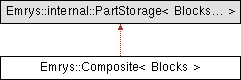
Inheritance diagram for Emrys::Composite< Blocks >:
Public Member Functions | |
| Composite (Blocks... blocks) | |
| The concatenation of blocks, with their parameters and sizes. | |
| template<std::size_t I> | |
| auto const & | block () const |
| template<std::size_t I> | |
| auto & | block () |
| Eigen::Index | valueDimension () const |
| template<std::size_t I> | |
| Eigen::Index | offset () const |
| void | resize (Eigen::Index n) |
| Resizes the composite's only resizable block, at any depth, so the composite has n coordinates. | |
|
template<typename Derived> requires ((internal::HasNormalize<Blocks> || ...)) | |
| void | normalize (Eigen::MatrixBase< Derived > const &rows) const |
| Normalizes each block's rows; a composite of blocks without normalize() has none. | |
|
template<typename X, typename D, typename Out> requires ((internal::HasPlus<Blocks> || ...)) | |
| void | plus (Eigen::MatrixBase< X > const &x, Eigen::MatrixBase< D > const &d, Eigen::MatrixBase< Out > const &out) const |
| \( x \boxplus \delta \) block by block, for a composite with a block that has its own plus(); see Emrys::plus(). | |
|
template<typename A, typename B, typename Out> requires ((internal::HasMinus<Blocks> || ...)) | |
| void | minus (Eigen::MatrixBase< A > const &a, Eigen::MatrixBase< B > const &b, Eigen::MatrixBase< Out > const &out) const |
| \( a \boxminus b \) block by block, for a composite with a block that has its own minus(); see Emrys::minus(). | |
| Composite< DifferenceSpace< Blocks >... > | difference () const |
| The composite of the blocks' difference spaces, with their sizes. | |
Static Public Attributes | |
| static constexpr int | FixedValueDimension |
| the blocks' fixed coordinates together | |
| static constexpr int | ValueDimensionStep = strides() |
| Zero if fixed; otherwise the greatest common divisor of its resizable blocks' strides, which every change in its value dimension is a multiple of. | |
| static constexpr int | MaxValueDimension |
The sum of the blocks' bounds, or Eigen::Dynamic if any is unbounded. | |
Friends | |
| bool | operator== (Composite const &, Composite const &)=default |
| Equal when every stored parameter and size is; a fixed-size Composite is always equal. | |
Detailed Description
template<Space... Blocks>
class Emrys::Composite< Blocks >
class Emrys::Composite< Blocks >
The concatenation of Blocks, any number of them resizable.
Nesting a named composite names a range of coordinates; storage is always the flat concatenation. Each block's offset is the total size of the blocks before it, so a block after a resizable one has its offset only at run time, from idx<Path>(space). A composite of empty blocks, such as any fixed-size composite of the coordinate types, is itself an empty type, so it costs a distribution nothing.
A composite with one resizable block, at any depth, has resize(n). One with several has none, since a length does not say how to split it among them: its blocks are resized through block(), or through a distribution's insert() and erase().
Member Function Documentation
◆ block() [1/2]
template<Space... Blocks>
template<std::size_t I>
|
inlinenodiscard |
- Returns
- block I, to resize it
◆ block() [2/2]
template<Space... Blocks>
template<std::size_t I>
|
inlinenodiscard |
- Returns
- block I
◆ difference()
template<Space... Blocks>
|
inlinenodiscard |
The composite of the blocks' difference spaces, with their sizes.
It keeps no tags, the blocks' or its own, even where every block is linear.
◆ offset()
template<Space... Blocks>
template<std::size_t I>
|
inlinenodiscard |
- Returns
- the offset of block I's first coordinate
◆ valueDimension()
template<Space... Blocks>
|
inlinenodiscard |
- Returns
- the number of coordinates: the blocks' sizes together
Member Data Documentation
◆ FixedValueDimension
template<Space... Blocks>
|
staticconstexpr |
Initial value:
=
(Blocks::FixedValueDimension + ...)
the blocks' fixed coordinates together
◆ MaxValueDimension
template<Space... Blocks>
|
staticconstexpr |
Initial value:
=
((Blocks::MaxValueDimension == Eigen::Dynamic) || ...) ? Eigen::Dynamic : (Blocks::MaxValueDimension + ...)
The sum of the blocks' bounds, or Eigen::Dynamic if any is unbounded.
The documentation for this class was generated from the following file:
- EmrysFilter/Spaces/Composite.h