Loading...
Searching...
No Matches
Emrys::Periodic< Interval, Dimension_, MaxDimension_ > Class Template Reference
Dimension_ coordinates that wrap with a common period, such as angles or DFT bins. More...
#include <EmrysFilter/Spaces/Coordinates.h>
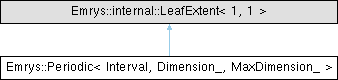
Inheritance diagram for Emrys::Periodic< Interval, Dimension_, MaxDimension_ >:
Public Member Functions | |
| Periodic (Eigen::Index n) | |
| n coordinates of a resizable Periodic. | |
| template<typename Derived> | |
| void | normalize (Eigen::MatrixBase< Derived > const &block) const |
| Wraps every value in block into [lower(), upper()), writing through the const reference (see writable()). | |
| auto | difference () const |
| The Periodic on [-period()/2, period()/2), with the same size. | |
Static Public Member Functions | |
| static consteval double | lower () |
| static consteval double | upper () |
| static consteval double | period () |
Static Public Attributes | |
| static constexpr int | FixedValueDimension |
| the fixed coordinates (see Space) | |
| static constexpr int | ValueDimensionStep |
| one coordinate per element if resizable | |
| static constexpr int | MaxValueDimension = MaxDimension_ |
| the largest valid size, or Eigen::Dynamic | |
Friends | |
| bool | operator== (Periodic const &, Periodic const &)=default |
| Equal when every stored parameter and size is; a fixed-size Periodic is always equal. | |
Detailed Description
template<PeriodicInterval Interval, int Dimension_ = 1, int MaxDimension_ = Dimension_>
class Emrys::Periodic< Interval, Dimension_, MaxDimension_ >
class Emrys::Periodic< Interval, Dimension_, MaxDimension_ >
Dimension_ coordinates that wrap with a common period, such as angles or DFT bins.
Values are kept in [lower(), upper()) and differences in [-period()/2, period()/2): the difference space is the Periodic on that interval, so RadiansPi is its own and Degrees360's is Degrees180. The interval is a template argument, so a fixed-size Periodic is an empty type: struct Bin : Periodic<{.lower = 0.0, .upper = 256.0}> {};. The interval has no default [coordinate-parameters]. The common angles are named RadiansPi, Radians2Pi, Degrees180, and Degrees360.
A Gaussian on a Periodic coordinate is a Gaussian in its tangent space, valid while its standard deviation is small against the period; a spread on the order of the period is better held by particles, a grid, or a mixture [tangent-gaussians].
Member Function Documentation
◆ lower()
template<PeriodicInterval Interval, int Dimension_ = 1, int MaxDimension_ = Dimension_>
|
inlinestaticnodiscardconsteval |
- Returns
- the lower end of the interval of values
◆ period()
template<PeriodicInterval Interval, int Dimension_ = 1, int MaxDimension_ = Dimension_>
|
inlinestaticnodiscardconsteval |
◆ upper()
template<PeriodicInterval Interval, int Dimension_ = 1, int MaxDimension_ = Dimension_>
|
inlinestaticnodiscardconsteval |
- Returns
- the excluded upper end of the interval of values
Member Data Documentation
◆ FixedValueDimension
template<PeriodicInterval Interval, int Dimension_ = 1, int MaxDimension_ = Dimension_>
|
staticconstexpr |
Initial value:
=
Dimension_ == Eigen::Dynamic ? 0 : Dimension_
the fixed coordinates (see Space)
◆ ValueDimensionStep
template<PeriodicInterval Interval, int Dimension_ = 1, int MaxDimension_ = Dimension_>
|
staticconstexpr |
Initial value:
=
Dimension_ == Eigen::Dynamic ? 1 : 0
one coordinate per element if resizable
The documentation for this class was generated from the following file:
- EmrysFilter/Spaces/Coordinates.h